


A potential user asked us a fair question recently:
What resources or performance studies does Transition use to set weekly workout plans and individual workout sessions? Is there science behind it, or is it entirely AI based?
Here is the short version:
Transition uses AI, but it is not just asking AI to make up workouts. The plans are shaped by endurance coaching principles, your training data, your race goals, your available time, and feedback from real athletes training for real races.
AI helps us apply that context quickly and personally. It is the tool, not the philosophy.
If You're Skimming
| Question | Our answer |
|---|---|
| Is it entirely AI based? | No. AI is used inside a coaching framework. |
| Does it use athlete data? | Yes. Recent training, race goals, availability, benchmarks, devices, and notes all matter. |
| Does it follow training principles? | Yes. Progression, specificity, recovery, and consistency are the backbone. |
| Do we publish the full prompt? | No. We share the philosophy, not the internal playbook. |
| How does it improve? | Real athlete feedback, internal review, and a large volume of training decisions. |
What We Learn From Real Transition Athletes
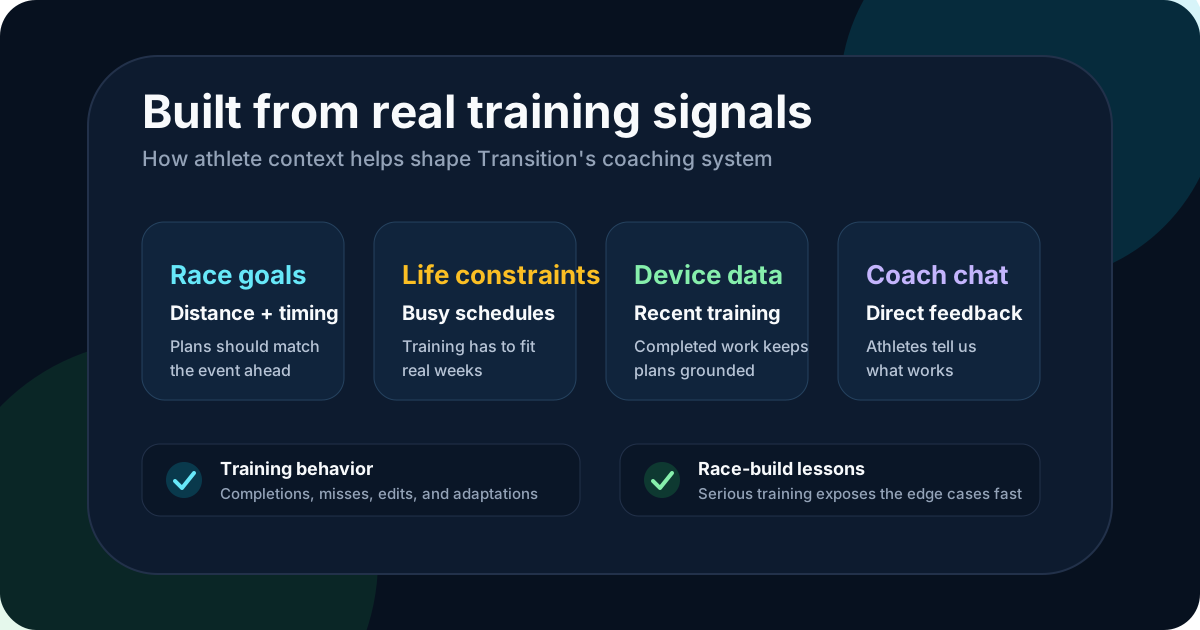
This is not a peer-reviewed study, and we would not pretend it is. It is a product-learning loop from real athletes using Transition in real training blocks.
Why include it? Because it explains how we think about the product. Transition is not being tuned around imaginary beginner personas. It is being shaped by athletes who are actually training: busy age-groupers, 70.3 athletes, Ironman athletes, first-timers, marathoners, and cyclists with real device data and real schedule problems.
We have also started publishing broader checks on our own training data, like whether athletes who use AI coaching actually get fitter. Those analyses are part of the same habit: do not just say the coaching works. Keep looking at what athletes actually do.
Our Coaching Philosophy
Good endurance training is not about finding the hardest possible week. It is about stacking the right work at the right time, recovering enough to absorb it, and staying consistent long enough for fitness to show up.
| We prioritize | Because |
|---|---|
| Gradual progression | Fitness builds from repeatable training, not sudden spikes. |
| Race specificity | A 70.3 build should not feel like a generic fitness plan. |
| Recovery | The body adapts after the work, not just during it. |
| Clear purpose | Every session should have a reason to exist. |
| Real-life fit | A plan only works if it survives work, family, travel, weather, and fatigue. |
Most athletes do not need a perfect theoretical plan. They need a good plan they can actually follow.
What Shapes A Plan
Think of Transition as four layers working together:
| Layer | What it adds |
|---|---|
| Training principles | Progression, recovery, specificity, and consistency. |
| Athlete context | Race date, weekly availability, experience, equipment, and preferences. |
| Performance data | Recent sessions, connected devices, thresholds, and training history. |
| AI adaptation | The ability to turn changing context into a coherent week quickly. |
This is where personalization matters. A 70.3 athlete with a deep training history should not get the same plan as a first-time sprint athlete with limited weekly availability and no recent swimming.
Where AI Fits
AI is useful because training context is messy:
| Real-life change | What a good coach should do |
|---|---|
| You miss two workouts | Adjust without panic or punishment. |
| Your long ride moves | Keep the week balanced around it. |
| You report soreness | Reduce risk and protect the bigger goal. |
| Your race gets closer | Make the work more specific. |
| Your device data updates | Let better data sharpen the plan. |
That is where AI helps. It lets Transition respond to the week in front of you without losing the bigger training arc.
That is the balance we are aiming for: adaptive, but not chaotic.
How We Keep Improving
We do not publish our exact internal prompts, rules, or edge-case handling. Those details are the result of a lot of iteration, and they are also not what most athletes need in order to trust the product.
What we can say is that the system keeps improving through three loops:
| Loop | What we learn |
|---|---|
| Internal review | Whether plans are coherent, useful, and safe enough to ship. |
| Athlete behavior | What people complete, miss, move, edit, or ask the coach to change. |
| Race-build feedback | Where serious 70.3 and Ironman training exposes edge cases faster than theory can. |
That feedback does not replace training science. It helps us apply it better.
Our Coaching Voice
The plan matters, but the way it is communicated matters too.
Transition should not sound like a hype machine. It should not bury you in jargon either. The voice we aim for is warm, direct, and specific: enough context to understand the plan, enough honesty to push back when something is unwise, and no fake motivation when what you really need is a clear adjustment.
Sometimes coaching means giving you a hard session. Sometimes it means telling you the easy day should stay easy.
The Bottom Line
Transition is science-informed, AI-assisted, and athlete-centered.
We use AI because it lets us adapt quickly. We use training principles because flexibility without structure is not coaching. We use athlete data because generic plans only go so far. And we keep listening to real users because real training is always messier than a perfect calendar.
The goal is not to make the fanciest plan. It is to help you train consistently, stay healthy, and show up on race day with work in the bank.


