

We built Transition to help endurance athletes train smarter. But does it actually work? That's not a question we can answer with marketing copy—so we ran the numbers.
We analyzed fitness data across our entire user base to answer a straightforward question: do athletes who actively follow Transition's AI-generated training plans get fitter than those who don't?
The short answer: yes, and it's not even close.
How We Measured Fitness
We used CTL (Chronic Training Load)—the gold standard metric for tracking endurance fitness over time. CTL is a 42-day exponentially weighted moving average of daily training stress (TSS). It's the same metric used by TrainingPeaks, WKO, and every serious coaching platform.
A higher CTL means your body has absorbed more consistent training load. It's not a perfect proxy for race fitness, but it's the best single number we have for "how trained is this athlete right now."
Every user's CTL was calculated using the exact same algorithm our app uses—factoring in their synced activities from Strava, Garmin, and Apple Watch, along with manually completed workouts. Where available, we used each athlete's actual performance thresholds (FTP, lactate threshold HR, swim CSS). For athletes without explicit thresholds, the system estimated them—just like it does in the app.
How We Defined "Active" vs. "Inactive"
We split users into two groups based on how much they engaged with Transition's training plans over the last 90 days:
| Group | Definition | Users |
|---|---|---|
| Active | Completed 12+ planned workouts in 90 days (~1+/week) | 268 |
| Inactive | Completed fewer than 4 planned workouts in 90 days | 563 |
Critically, both groups had synced activity data from Strava, Garmin, or Apple Watch. This means inactive users weren't sedentary—they were athletes who train and record their workouts, but don't follow Transition's AI-generated plans. This is an apples-to-apples comparison between athletes who use the coaching and athletes who don't.
We excluded a middle zone (4–11 completions) to create clean separation between the groups.
The Results
Active Users Are Significantly Fitter
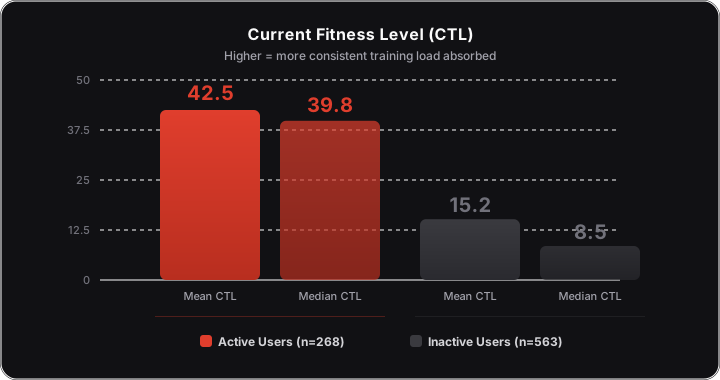
Active Transition users have a mean CTL nearly 3x higher than inactive users. The median tells an even starker story—39.8 vs. 8.5, almost a 5x difference.
To put this in context: a CTL of 40 represents a solid recreational athlete with consistent training. A CTL under 10 means very little structured training load.
Active Users Are Gaining Fitness Faster
We didn't just look at where users are—we looked at where they're heading. Over the last 60 days:
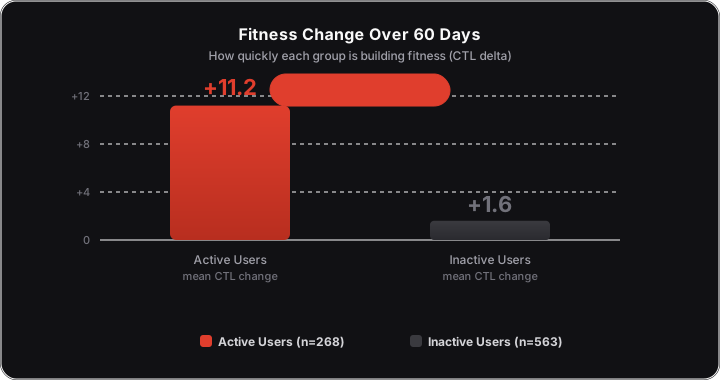
Active users are building fitness at 7x the rate of inactive users. They're not just fitter today—they're on a steeper upward trajectory.
The Fitness Distribution Gap
The distribution breakdown makes the gap even more visible:
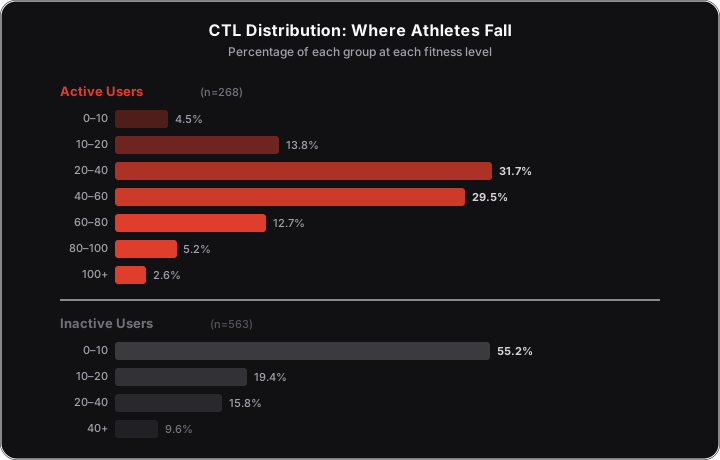
The vast majority of inactive users (55%) are below a CTL of 10—barely accumulating training stress. Active users cluster in the 20–60 range, where real fitness adaptations happen. Over 21% of active users sit above 60, representing serious endurance athletes.
It's Statistically Significant
We didn't stop at averages. We ran Welch's t-tests and calculated effect sizes:
| Test | t-statistic | p-value | Effect Size (Cohen's d) |
|---|---|---|---|
| Current CTL | 16.3 | < 0.001 | 1.32 (large) |
| CTL Change (60d) | 6.7 | < 0.001 | 0.61 (medium) |
Both comparisons are highly significant (p < 0.001). The effect size for current fitness is large by any standard—this isn't a marginal difference.
Training Volume: Part of the Story
Active users also logged significantly more activities—115.6 over 90 days compared to 39.7 for inactive users (about 3x more). This makes sense: following a structured plan naturally means training more consistently.
But volume alone doesn't tell the whole story. The quality and structure of training matters. An athlete doing 4 random workouts a week will accumulate less fitness than one doing 4 purposeful, periodized workouts that build on each other. That's what AI coaching provides—not just more training, but the right training at the right time.
The Honest Caveats
We're not going to pretend this is a randomized controlled trial. Here's what you should know:
Selection bias is real. More motivated, experienced athletes are probably more likely to follow a training plan in the first place. Some of the fitness gap likely reflects pre-existing differences in commitment and athletic background—not just the effect of using Transition.
Threshold estimation matters. CTL calculations depend on personal performance thresholds (FTP, lactate threshold HR, swim CSS). 81% of active users and 98% of inactive users relied on estimated thresholds. This could introduce some noise, though both groups are affected.
Correlation isn't causation. We can say with high confidence that active Transition users are fitter and improving faster. We can't say with certainty that Transition caused all of that improvement. The truth is likely a feedback loop: structured training helps you get fitter, and getting fitter motivates you to keep following the plan.
What This Means for You
Even accounting for the caveats, the data paints a clear picture: athletes who follow structured, AI-generated training plans are in a fundamentally different fitness category than those who don't.
If you're currently training without a plan—or with a static plan that doesn't adapt to your life—you're likely leaving significant fitness gains on the table. The athletes in our active group aren't superhuman. They're following a plan that adjusts to their schedule, responds to their actual performance data, and builds progressive training load over time.
That's what Transition does. And the numbers back it up.
This analysis was conducted on March 29, 2026, across 2,355 Transition users. Fitness calculations used the same CTL/PMC algorithm that powers the app, with 180 days of training history per user. All data was anonymized and aggregated.


