

We all know the feeling. You plan to train five days a week, but life gets in the way. A skipped session turns into a skipped week, and suddenly your fitness goals feel miles away. Consistency is the hardest part of endurance sports.
At Transition, we wanted to understand what separates the users who train sporadically from those who show up day after day.
We recently analyzed training data from hundreds of our users, split into two distinct groups: those with at least one race added to their calendar, and those without.
The results weren't just surprising—they were staggering. The data confirmed what many coaches have long suspected: concrete goals drive concrete action.
Here is a summary of our research findings on how adding a race changes athlete behavior.
The "Race Effect": By The Numbers
Our analysis revealed that users who have committed to an upcoming event aren't just slightly more active; they are fundamentally operating at a different level of engagement.
Here are the three key findings from our research:
1. The Overall Activity Boost
The most immediate takeaway is the sheer volume of work being done. When an athlete has a race date looming, their overall activity metrics jump significantly across the board.
Compared to users with no scheduled events, users with races logged:
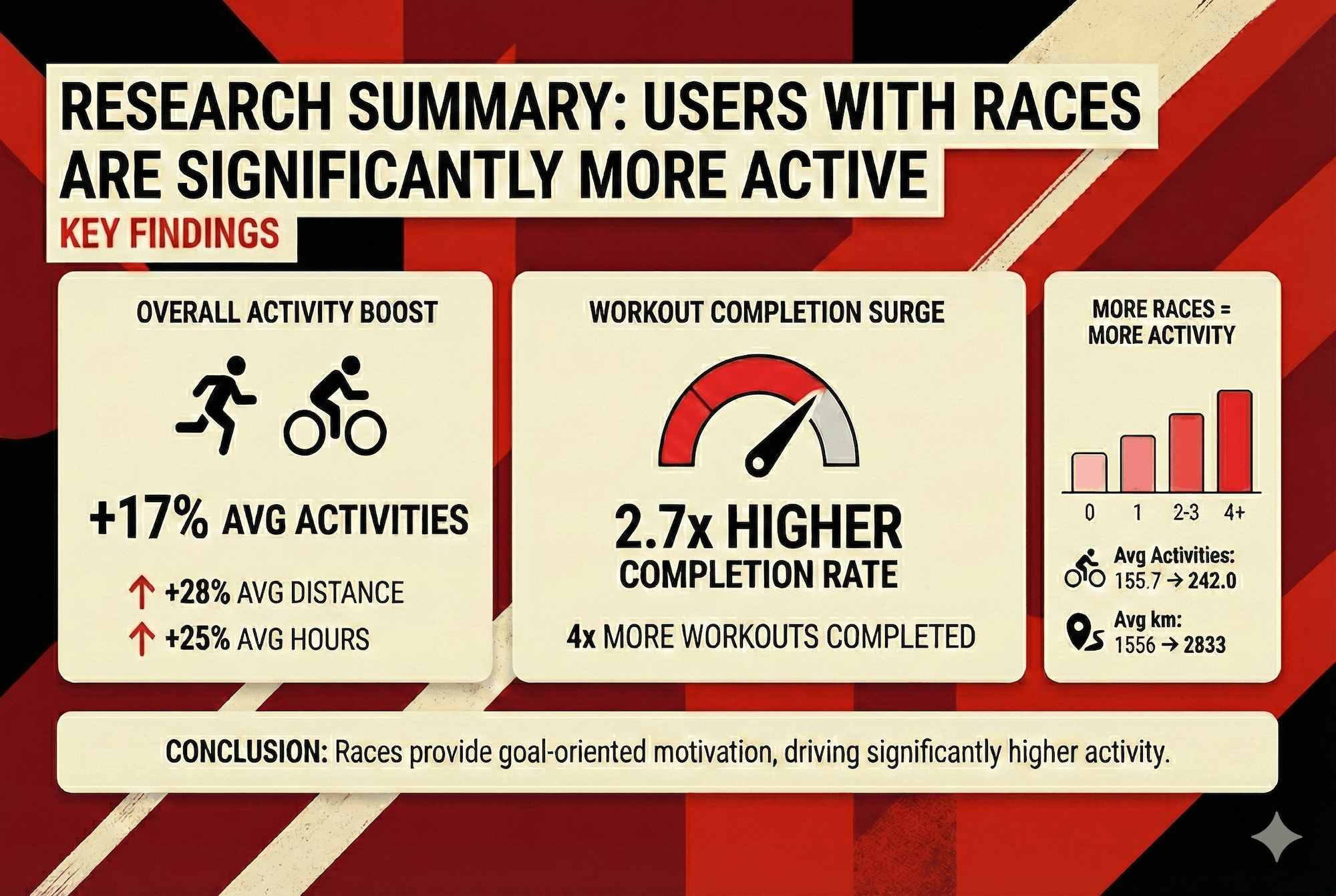
- +17% higher average activity count
- +28% more total distance covered
- +25% more hours spent training
2. The Workout Completion Surge (The Most Critical Find)
While total volume is interesting, the most revealing statistic is adherence. It's easy to log junk miles; it's much harder to stick to a structured plan when you're tired or busy.
This is where the difference is most stark. Users with a race on the calendar don't just train more; they follow through on structured plans far more effectively.
- They follow structured plans at a 2.7x higher completion rate
- Over a 90-day period, they completed 4x more structured workouts than non-racers
The takeaway? A race forces you to prioritize quality sessions over skipping them.
3. "Dose-Response": More Races = More Activity
Is one race enough? Yes, but our data shows a clear trend: the more committed you are to an event schedule, the more consistent your training becomes.
We observed a clear "dose-response" relationship. As users added more races (moving from 0 to 1, to 2-3, and finally 4+ events), their average activities and distance climbed steadily. The most active users in our entire database were those juggling calendars with 4 or more scheduled events.
Visualizing the Data
We compiled these findings into the infographic below to illustrate just how powerful the "race effect" is on training habits.
Conclusion: The Power of Goal-Oriented Motivation
The data is clear: abstract goals ("I want to get fit") rarely compete with concrete deadlines ("I have a 10K in 8 weeks").
Races provide goal-oriented motivation. They transform training from something you should do into something you need to do to prepare for a specific day. This deadline drives engagement, increases volume, and, most importantly, drastically improves adherence to structured workouts.
The Takeaway for You: If you are struggling with consistency in your training, stop relying on willpower alone. The single best thing you can do for your fitness right now is to find an event—a local 5K, a sportive, a triathlon, anything that excites you—pay the registration fee, and put it on your calendar.
Your future self (and your training log) will thank you.


